
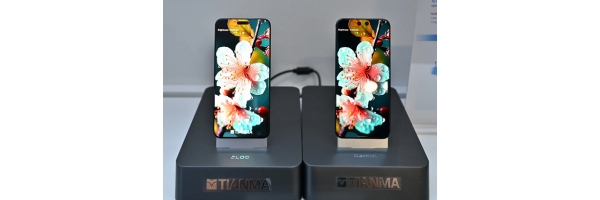
At SID Display Week 2026, Tianma introduced SLOD (Stacked Layer OLED Device) — a proprietary AM-OLED architecture that reworks how stacked emissive layers share the power and voltage budget. Tianma demonstrated the technology on a 6.78″ AM-OLED panel, positioned within a broader consumer display portfolio aimed at smartphones and wearables.
Why Stack OLED Layers at All
Tandem, or stacked, OLED structures aren’t new. The general idea has been around for years: instead of driving a single emissive layer harder to get more brightness, split the current across two stacked emissive units. Each unit runs at lower current density, which typically improves efficiency and slows the material degradation that limits OLED lifespan. The tradeoff has historically been voltage — stacking units in series usually means driving the stack at a higher voltage than a single-layer device would need, which eats into the power savings the structure is supposed to deliver.
What SLOD Changes
Tianma’s SLOD architecture targets that tradeoff directly. The key structural change sits in the charge generation layer (CGL) — the interface between the two stacked emissive units that governs how charge carriers are generated and passed between layers. Tianma’s CGL is designed to operate at a notably lower device voltage than conventional tandem structures, and it’s paired with a differentiated light-emitting unit configuration between the two stacked layers, rather than two identical units.
The combined effect is a structure where one emissive layer, working together with a differentiated second layer, produces more light output than two conventional stacked layers would under equivalent drive conditions — without requiring the voltage penalty typically associated with tandem designs.
The Numbers
Compared to a single-layer OLED device, Tianma reports:
| Metric | Change vs. single-layer device |
|---|---|
| Power consumption | ~30% lower |
| Brightness | ~25% higher at equivalent input |
| Lifespan | Up to 4x longer |
These three figures move together rather than trading off against each other, which is the more unusual part of the result. Conventional tandem OLED gains in efficiency or lifespan often come with a voltage or complexity cost; SLOD’s CGL redesign is aimed at collecting the lifespan and efficiency benefits of a stacked structure without giving back headroom on the voltage side.
Where It Sits in Tianma’s Portfolio
The 6.78″ SLOD panel was shown alongside Tianma’s U11 OLED stack, which uses a separate technology — New Fluorescent Technology (NFT), built on Phosphor-Sensitized Fluorescence and New Fluorescent Blue material systems — aimed at color fidelity rather than the stack architecture itself. The two are complementary tracks in Tianma’s roadmap rather than the same innovation: NFT targets emissive material efficiency and color, while SLOD targets device architecture and drive efficiency. Both were framed as part of Tianma’s push toward higher color fidelity, improved energy efficiency, increased brightness, longer device lifetime, and greater design flexibility for next-generation smartphones and wearables.
What to Weigh in a Display Trade Study
A few practical points worth checking before slotting SLOD into a design:
- Battery vs. enclosure tradeoffs. A ~30% power reduction at the panel level can be reallocated toward a smaller battery, a thinner enclosure, or simply more runtime at the same battery size — the right call depends on the product’s constraints.
- Product lifecycle. A 4x lifespan extension matters most for products with multi-year expected service life (industrial handhelds, medical devices, longer-refresh-cycle wearables) where OLED burn-in or luminance decay over time is a real design constraint, not just a spec-sheet number.
- Drive electronics compatibility. Any CGL and voltage change at the panel level has implications for the driver IC and power delivery design; confirm compatibility with your existing drive scheme early rather than late.
- Maturity. As of this writing, SLOD has been shown as a demonstration panel at Display Week 2026. Tianma has not published a broad production timeline or part-number availability beyond the demo, so treat it as an architecture to design toward rather than a drop-in component today.
Next Steps
For engineering samples, datasheets, or roadmap timing on SLOD panels, Envision Technical Sales can connect you directly with Tianma’s applications engineering team.
[You can directly reach out to us at sales@envts.com]